Mahjong is a tile game that began in China and has grown a different set of rules almost everywhere it landed. The American version is the one played across the United States, and its rules are set each year by the National Mah Jongg League.
If you have played rummy, you already know the shape of it. You hold a hand, you draw a tile, you throw one away, and you are trying to be first to build a complete pattern.
One thing makes the American game unlike any other: the winning patterns are printed on a card, and a new card comes out every year. When the card changes, the hands you are chasing change with it.
What you will learn
The tiles — the suits, dragons, winds, flowers and jokers
The Charleston — the tile-passing ritual that opens every game
How a hand is played, and how you win it
Reading the card, calling tiles, joker rules and scoring
Nine short chapters. Take them in order the first time.
Chapter 2 of 9
The Tiles
A set has 152 tiles. Most of them belong to three numbered suits; the rest are dragons, winds, flowers and jokers.
The three suits
Craks (Characters) — numbered 1 to 9, marked with Chinese characters
Bams (Bamboo) — numbered 1 to 9, drawn as bamboo sticks
Dots (Circles) — numbered 1 to 9, drawn as circles
There are four of every numbered tile.
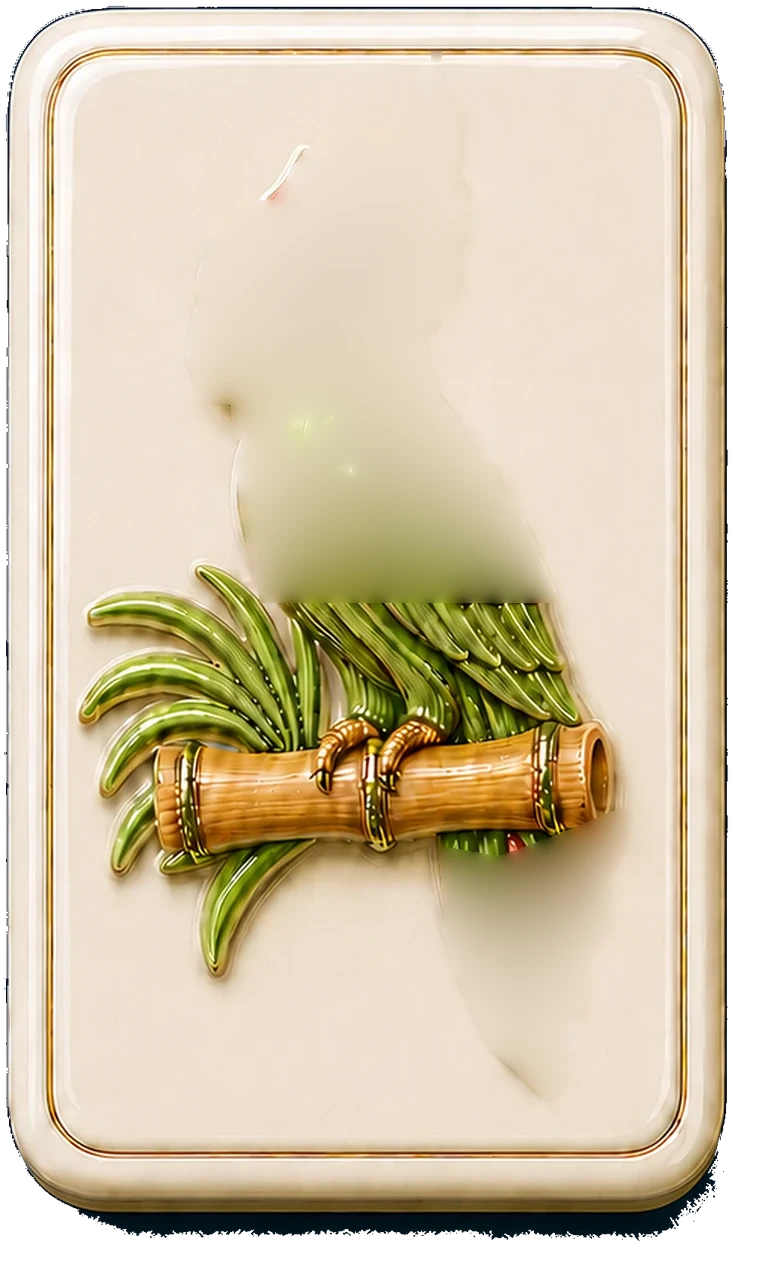
The 1 Bam is the odd one out. Instead of a single bamboo stick it shows a bird — which is why it is the tile on this page.
Dragons
Three kinds, and each one is tied to a suit: Red with Craks, Green with Bams, White with Dots. That pairing turns up again and again in the card’s patterns.
The White Dragon is almost always called the Soap, because it is blank or nearly blank and looks like a bar of it.
Winds
North, East, West and South — four of each. Players say them in that order, NEWS, because it spells something you can remember.
Flowers
Eight flower tiles. They are interchangeable: any flower counts as any other.
Jokers
Eight wildcards. They are powerful and heavily restricted, and they have a chapter of their own later on.
Chapter 3 of 9
How a Game Works
A hand moves through four stages. You do not need to memorise any of this now — each stage gets its own chapter.
The dealEveryone receives 13 tiles. The dealer, called East, gets 14. What is left forms the wall, which is the pool everybody draws from.
The CharlestonBefore play begins, players pass tiles around the table. This is your chance to get rid of what you cannot use and pick up something you can.
PlayOn your turn you draw a tile and discard one, so your hand stays at 13. Play moves counterclockwise. You are working toward one of the patterns on the card.
WinningWhen your 14 tiles match a pattern on the card, you declare Mahjong and the hand is over.
A hand usually takes ten to twenty minutes. A game is however many hands you agree to play.
Chapter 4 of 9
Reading the Card
The card is the whole game. It is a printed sheet from the National Mah Jongg League listing every hand that counts as a win that year, and you play with it in front of you. A line might read FF 1111 11 1111 DD.
Reading it takes a few sittings. Here is enough to start.
The letters
1–9 — a numbered tile from one of the suits
F — Flower
D — Dragon
N, E, W, S — the four winds
0 — Soap, the White Dragon
Groups
A hand is built from groups of identical tiles. How many are in the group decides what it is called:
Single — one tile
Pair — two identical
Pung — three identical
Kong — four identical
Quint — five identical
Sextet — six identical
Some lines look like groups but are not. NEWS is four different wind tiles, and a year like 2026 is four different numbers. Both are sets of singles, which matters enormously once jokers come in.
The colours
Patterns are printed in red, green and blue. The colours do not name specific suits — they describe relationships. Tiles printed in the same colour must come from the same suit, and tiles in different colours must come from different suits. Which suit you choose is up to you.
Chapter 5 of 9
The Charleston
Before anyone plays a tile, everybody trades. The Charleston is named after the 1920s dance, and it is where a hopeless opening hand becomes a playable one.
The passes
First Charleston — requiredThree passes of three tiles each: to the right, then across, then to the left.
Second Charleston — optionalThree more, the other way round: left, across, right. Any player can call it off if their hand is already close.
Courtesy pass — optionalA last swap of up to three tiles with the player opposite you. You both have to agree on how many.
Blind pass: on the last pass of each Charleston you may push through tiles you were just handed without looking at them. Useful when your hand is good and you would rather not break it up.
What to pass
Lone winds and dragons you have no pattern for
Single tiles from a suit you are not committing to
Anything that does not appear in the hands you are considering
Never pass a joker. You cannot get it back, and it is the most valuable tile in the game.
Chapter 6 of 9
Calling Tiles
You do not only get tiles on your own turn. When any player discards a tile you need, you can call it — claim it out of the discard and put it straight into your hand.
It is the strongest move in the game, and the easiest to get wrong.
When you may call
Only when the tile completes a group of three or more identical tiles — a pung, kong or quint.
You cannot call a tile to make a single or a pair, and you cannot call to make a run. The one exception is calling for Mahjong.
What happens when you call
Say "call"Speak before the next player draws, or the moment has passed.
Take the tileThe discard comes to you.
Expose the groupLay the finished group face up in front of you. Everyone can see it for the rest of the hand.
DiscardThrow one tile away, as you would on a normal turn.
Play resumes from youAnyone sitting between you and the discarder loses their turn.
The cost is information and flexibility. An exposed group is locked — those tiles cannot go back into your hand, and the table now knows a great deal about what you are building.
Calling for Mahjong
If a discard is the very last tile you need, you can call it to win, even for a single or a pair. This is the only time that is allowed.
Chapter 7 of 9
Joker Rules
Jokers are wildcards with sharp edges. Misusing one is among the most common ways a new player throws away a hand.
Jokers can
Stand in for any tile inside a group of three or more identical tiles — a pung, kong or quint
Be held in hand indefinitely, as many as you like
Be swapped for on your turn, if another player has one sitting in an exposed group
A pung of 7 Dots can be two real 7 Dots and a joker. A kong of East can be three Easts and a joker, or two Easts and two jokers. The group only has to be three or more of the same tile.
Jokers cannot
Be used as a single
Be used in a pair
Be used in a run such as 1-2-3, because those tiles are not identical
Be used in a year hand like 2026 — four different tiles, so four singles
Be used in NEWS — again four different tiles
A discarded joker is dead. Throw one away by accident and it is gone for the hand: nobody may call it and nobody may use it. Many players keep their jokers apart in the rack for exactly this reason.
Joker swaps
If a joker is standing in for a tile in someone’s exposed group, and you hold the real tile, you may trade for it on your turn. Put the real tile into their group, take the joker for yourself.
Chapter 8 of 9
Scoring
Every hand on the card has a point value printed at the end of its line. When you win, that number is what the other three players pay you. Two bonuses can multiply it, and how you won decides who pays what.
Table scoring
This is how casual and club games are played.
The winner collects the hand’s value from each of the other three players
Jokerless win — no jokers in your hand at all — doubles the value
Self-pick — you drew the winning tile yourself — doubles what everyone pays
Won on a discard — the player who threw it pays double, the other two pay the base value
A worked example
Take a 25 point hand.
Won on a discard, with jokers: the discarder pays 50, the others 25 each. You collect 100.
Self-picked, with jokers: all three pay 50. You collect 150.
Self-picked and jokerless: the jokerless bonus doubles the hand to 50, then self-pick doubles what each pays. All three pay 100. You collect 300.
The bonuses stack, which is why a jokerless self-pick is the biggest result in the game.
Singles-and-pairs hands do not get the jokerless bonus. Jokers are not legal in them anyway, so they are jokerless by definition — which is already priced into their higher value.
Chapter 9 of 9
Playing in Person
Online, setup happens for you. At a real table there is a short ritual first. It looks fussy the first time and becomes automatic by the third.
Building the walls
Think of it as shuffling a deck. In a card game you shuffle and stack in the middle for everyone to draw from. The four walls are that stack.
Shuffle face downMix every tile face down in the middle of the table, thoroughly.
Build your wallEach player stacks a wall in front of their rack: 19 tiles long, two tiles high — 38 tiles each.
Choosing the dealer
Roll for itEveryone rolls the dice. Highest roll is East, the dealer.
Break the wallEast rolls again. That number counts in from the right end of East’s wall, and that is where dealing starts.
Curtsy the tilesEast pushes the starting tiles out from the wall with the rack, so everyone can see where the deal begins.
The second roll is what stops anyone predicting which tiles they will be dealt.
Friends at Mahjong is an independent teaching and gaming resource and is not affiliated with, endorsed by, or sponsored by the National Mah Jongg League.